As 2026 gets underway, the music industry is entering a period of accelerated technological and commercial change. From AI-driven fraud to new fan monetisation models and real-time music in gaming, the way music is created, distributed, protected and experienced is evolving faster than ever.
Con Raso, Managing Director of Tuned Global, shares his perspective on seven key trends that are expected to define the year ahead and reshape how the industry operates.
Key music industry trends for 2026
- AI-driven fraud detection in streaming
- creator monetisation models expanding beyond royalties
- music experiences integrated into games and apps
- AI-powered music discovery and recommendation
- new licensing models for digital platforms
1. Streaming fraud has become industrialised and AI is both the problem and the solution
Streaming fraud remains one of the industry’s most pressing and least visible challenges. What was once the domain of individual bad actors has now evolved into something far more organised. “Experts in music fraud estimate streaming fraud at over a billion dollars a year, with around 80% of that fraud being executed by sophisticated networks,” Raso explains.
Fraudsters typically monetise this activity by repeatedly playing artificially generated or fraudulent tracks, sometimes made using unlicensed content. These streams are funnelled into the same royalty pool as legitimate plays, diverting revenue away from real artists. “In a pro-rata model, every fraudulent stream takes money away from genuine artists. It’s not extra money. It’s just unfairly dividing the same pie.”
AI is contributing to the problem, particularly through voice cloning and impersonation, but it is also becoming a critical part of the solution.
“AI gives us the ability to analyse deep behavioural patterns. Sophisticated fraud isn’t easy to catch manually, but with AI, it becomes possible.”
2. New fan engagement and payment models will gain momentum
The limitations of traditional royalty distribution models are becoming harder to ignore, particularly for independent artists and niche genres. In response, alternative payment models that better reflect actual listening behaviour are starting to gain traction.
“Becoming more user-centric means that if someone listens to only one artist all month, and five dollars of their subscription goes towards royalties, that artist should receive the full amount,” says Raso.
In a pool-based system, that money is spread across the entire market, disproportionately benefiting the biggest artists and labels.
The real opportunity lies in enabling superfans to actively support the artists they love.
 “With social radio and tipping models, fans can directly support artists they’ve chosen. Superfans don’t want to engage passively. They want to participate.”
Raso points to markets like Japan, where fan loyalty is demonstrated through repeated purchases and deep engagement, as a blueprint for what is possible globally.
3. AI will become the primary user of music APIs
As AI agents become more capable, the way music infrastructure is accessed and used will change fundamentally. Rather than developers interfacing directly with APIs, AI systems will increasingly act as the primary operators.
“We’re moving towards a future where AIs are querying music systems directly,” Raso explains. “That’s where technologies like Model Context Protocol come into play, allowing AI platforms to use our APIs as if they were an extension of themselves.”
In practical terms, developers may define what they want to build, while AI handles much of the underlying integration and orchestration.
“It won’t remove the developer, but it will remove a lot of the plumbing.”
As a result, the addressable market for music technology is set to expand well beyond traditional streaming platforms.
4. Gaming will adopt real-time, adaptive music experiences
Gaming is moving beyond static soundtracks and traditional sync licensing. In 2026, music will increasingly adapt dynamically to gameplay in real time.
“That could be as simple as an AI analysing what’s happening in the game and adapting the music style to match the experience,” says Raso.

Unlike pre-programmed soundtracks, real-time adaptation allows music to respond instantly to players, environments and in-game events.
“These opportunities exist now because technology has finally caught up. Twelve months ago, many of these use cases simply weren’t possible at scale.”
This shift opens new creative and commercial opportunities for both developers and rights holders.
5. DSPs will become far more selective about content
With the rapid rise of AI-generated music, digital service providers are facing an unprecedented volume of content. In response, platforms are expected to tighten curation standards significantly.
“The challenge is separating meaningful content from noise in recommendation pipelines, and that’s where data becomes absolutely critical,” Raso explains.
Rather than endlessly expanding their catalogues, DSPs are likely to prioritise quality and relevance.
“I don’t think a DSP wants to store a billion tracks. There will need to be a reason your music belongs on the platform.”
Spotify has already reportedly removed tens of millions of low-quality or spam-like tracks, and this trend is expected to accelerate across the industry.
6. Data and behavioural intelligence will become central to decision-making
Across fraud detection, content moderation, fan engagement and monetisation, data is becoming the common denominator. Platforms that can analyse behavioural signals in real time will be better positioned to:
- detect abnormal activity
- personalise experiences
- protect artists’ revenue
- justify content inclusion
7. Music technology will continue to expand beyond traditional streaming
Perhaps the most significant trend of all is the continued expansion of music into new environments. From gaming and fitness to wellness, health tech, automotive and beyond, music is becoming an embedded part of digital experiences rather than a standalone destination.
“The industry is no longer just about streaming apps,” says Raso. “It’s about how music enhances experiences across platforms, devices and industries.”
This creates new revenue models, new licensing challenges and new expectations for flexibility and speed.
What these trends mean for music platforms
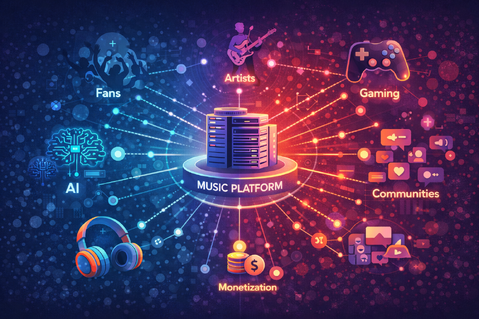
For music platforms and digital services, these trends highlight the growing importance of infrastructure such as music licensing systems, catalogue management tools, AI-driven metadata and scalable APIs that allow music to be integrated into new types of digital experiences.
Looking ahead
The music industry in 2026 will be defined by adaptability. Platforms that embrace AI responsibly, prioritise artist fairness, and build flexible, data-driven infrastructure will be best positioned to succeed.
As technology continues to blur the lines between music, gaming, wellness and interactive experiences, the role of music platforms will expand far beyond traditional boundaries.