As music streaming matures, new monetisation models are emerging beyond traditional DSP royalties. This article explores how direct-to-fan revenue, gaming environments, wellness applications and niche platforms are creating new opportunities for artists and music companies.
This article is part of Tuned Global’s SXSW series exploring the future of streaming in a superfan era. The series examines four themes shaping the next chapter of the music industry: fan engagement, monetisation beyond streaming, ecosystem integrity and new vertical opportunities.
Music streaming unlocked global distribution.
Streaming now represents around 69% of global recorded music revenues, according to the IFPI Global Music Report 2025, highlighting how dominant digital platforms have become in the modern music economy.
But distribution alone does not guarantee sustainability.
As Jordan Pettinato, Senior Director of Business Development and Partnerships at SoundCloud, stated clearly:
“Streaming alone is insufficient for independent artists.”
That statement defines the current inflection point in music economics.
The industry is now exploring new music monetisation models that extend beyond traditional streaming royalties.
The limits of the traditional DSP model
For most independent artists, streaming revenue provides incremental income — not full livelihood.
Even Fan-Powered Royalties, which have improved outcomes, often mean a shift from: “$100 a month to $250 a month.” added Jordan.
Meaningful. But not transformational on its own.
The old model assumed that scale would solve everything. The new model recognises that engagement monetises better than exposure.
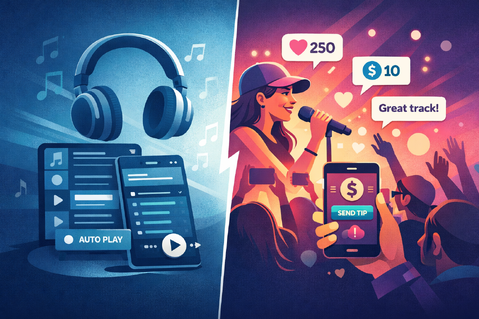
Direct-to-fan monetisation is expanding
Platforms are building layered monetisation tools:
- Direct tipping
- Patronage features
- Messaging
- Milestone-based promotion tools
- Vinyl on-demand manufacturing
- Growth engines guaranteeing initial plays
Jordan summarised the philosophy succinctly:
“Get heard, get fans, get paid.”
The order is critical. Monetisation is not the starting point. It is the outcome of community.
But monetisation is no longer confined to DSP environments.
New monetisation opportunities beyond traditional streaming
One of the most interesting developments in music right now is where monetisation is expanding outside traditional streaming platforms.
These opportunities sit in sectors where music becomes part of a broader experience rather than a standalone destination.
Con Raso highlighted gaming as one of the most under-capitalised areas for music:
“If you move music into the social platform of the gaming experience, it provides real opportunity.”
Why music licensing must evolve for gaming and interactive platforms
For these ecosystems to grow, licensing frameworks will need to adapt.
Traditional sync licensing works well for film and television, but it can become restrictive when music is embedded into interactive or social environments.
High upfront sync fees can limit experimentation in gaming, especially when music is used dynamically rather than as a fixed placement.
If music is going to function inside interactive environments, licensing models may need to evolve toward more flexible structures that support continuous use rather than one-time placements.
Industry insight
According to Con Raso, CEO of Tuned Global, some of the most promising opportunities for music monetisation lie in embedding licensed music inside new digital environments such as games, connected devices and emerging digital platforms.
The rise of derivative experiences
At the same time, listener behaviour is becoming more interactive.
Some platforms are experimenting with ways for fans to actively engage with songs themselves.
One example discussed was Audiomack’s AudioMod, a feature that allows users to modify playback of a song in real time while ensuring that all engagement still counts toward the original recording.
Other technologies are enabling similar possibilities at the platform level. AutomixIQ, for example, provides tools that allow streaming services to introduce dynamic playback experiences — such as adaptive mixing or transitions — while ensuring that streams and royalties remain correctly attributed to the original track.
This type of approach allows creative participation without fragmenting monetisation.
It also hints at how derivative experiences may become a normal part of music consumption. Historically, the industry has resisted these shifts — from remixes to user-generated content — before eventually embracing them.
The infrastructure powering the next generation of music platforms
None of these new monetisation layers work without strong infrastructure behind them.
Rights clearance, fingerprinting technologies and accurate metadata systems are essential if music is going to operate across gaming engines, health devices, telco platforms or interactive fan environments.
As Janishia Jones, who works on creator and rights infrastructure initiatives in the music ecosystem, noted, "Centralising data and automating copyright detection will be critical for supporting a more democratised music economy."
When music moves beyond DSPs, the backend systems that manage rights, catalogue delivery and reporting become even more important.
The next phase of the industry will be built on embedding music into new ecosystems.
Platforms, developers and new categories of companies will all need access to the tools that make that possible. Behind many of these emerging experiences is a new layer of infrastructure quietly enabling music to travel further than it ever has before.
Frequently Asked Questions
Why are new monetisation models emerging in music streaming?
Traditional streaming royalties alone often provide limited income for smaller independent artists, which is driving the growth of new monetisation models such as fan tipping, patronage systems and interactive music experiences.
What industries are creating new opportunities for music monetisation?
Gaming, wellness applications, children’s platforms and niche cultural music services are emerging as important areas where music can generate new revenue streams.
As music expands beyond traditional streaming platforms into gaming, wellness applications and specialised communities, companies exploring these opportunities need infrastructure that can handle licensing, catalogue management and fan engagement at scale.
This is where technology platforms like Tuned Global increasingly play a role behind the scenes, helping partners embed music into new types of digital experiences.
Join the conversation on March 15, 2026 at SXSW.
This article was written by the Tuned Global team following discussions with industry leaders including Con Raso (Tuned Global), Brian Zisook (Audiomack), Jordan Pettinato (SoundCloud) and Janishia Jones.