The music streaming industry is entering a superfan era where engagement signals such as saves, comments and fan interaction increasingly matter more than passive listening. This article explores how streaming platforms are evolving beyond plays, and what it means for monetisation, discovery and fan relationships.
In the lead-up to SXSW, Tuned Global CEO Con Raso joined industry leaders including Brian Zisook (Audiomack), Jordan Pettinato (SoundCloud) and Janishia Jones (Encore Music Technologies) to discuss the future of streaming in a superfan era.
This series explores four themes shaping the next chapter of the music industry: fan engagement, monetisation beyond streaming, ecosystem integrity and new vertical opportunities.
For years, the dominant narrative around music streaming has been simple: scale wins.
More subscribers, more catalogue, more algorithmic recommendations, more plays.
But the next era of streaming will not be defined by scale alone.
According to the IFPI Global Music Report 2025, global recorded music revenues reached $29.6 billion in 2024, continuing a decade of industry growth driven largely by music streaming services. As the music streaming industry matures at this scale, platforms are increasingly shifting focus from passive listening toward deeper fan engagement and community interaction.
Paid streaming subscriptions have now surpassed 700 million globally, underscoring the scale of the audience platforms are building relationships with.
Across the music streaming industry, platforms are beginning to prioritise fan engagement, ownership and community behaviour rather than passive listening volume.
We are not entering a “streaming is broken” phase. We are entering a superfan phase.
The shift from passive listening to active fan engagement
One data point captures the transition perfectly.
As Brian Zisook, Co-Founder of Audiomack, noted:
“Our number one stream source is the listener library.”
Not homepage playlists. Not algorithmic radio. Not passive autoplay.
Library.
That means listeners are choosing. Saving. Returning.
Jordan Pettinato, Senior Director of Business Development and Partnerships at SoundCloud, reinforced the same behavioural shift:
“The top session starts on SoundCloud come from the search page or the library page.”
Search and library behaviour signal intent.
Streaming’s first decade optimised for lean-back listening. Algorithmic discovery removed friction and democratised access.
But passive listening does not necessarily translate into fandom.
As Brian said plainly: “Play data can lie.”
A playlist spike may inflate streams. But it does not necessarily reflect resonance. What does?
- Comments
- Playlist adds
- Re-ups
- Offline downloads
- Direct messaging
- Tipping
- Saves
These are engagement signals. They indicate “stickiness and resonance.”
Superfans lean in.
They do not just consume. They curate, they interact, they amplify.
And increasingly, platforms are weighting those behaviours more heavily than raw volume.
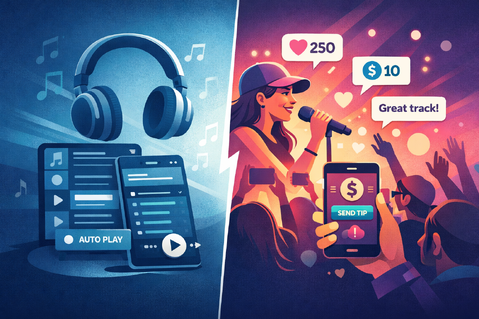
Streaming is shifting from distribution infrastructure to participation infrastructure.
What is the superfan era in music streaming?
The superfan era refers to a shift in music streaming where platforms prioritise deep engagement with dedicated fans rather than passive listening at scale. Instead of focusing only on play counts, platforms increasingly measure signals such as saves, comments, playlist additions and direct fan interaction.
The concept reflects a broader shift across music streaming platforms toward deeper fan relationships, community interaction and diversified revenue models.
Streaming alone is not enough
Engagement alone is not the full story. Monetisation must evolve alongside behaviour.
As Jordan Pettinato put it: “Streaming alone is insufficient for independent artists.”
That reality is driving structural innovation. Platforms are layering new tools on top of streaming:
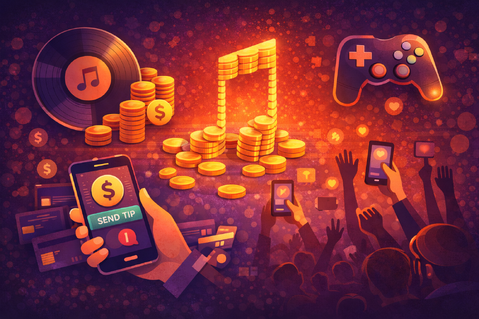
- Direct tipping
- Patronage models
- Fan support features
- Milestone-triggered promotion assets
- Growth engines guaranteeing exposure
- Vinyl-on-demand services
SoundCloud’s model is summarised clearly by Jordan: “Get heard, get fans, get paid.”
Audiomack enables authenticated artists to monetise directly, while tools like Promote auto-generate marketing assets so artists can celebrate milestones without needing to become graphic designers.
SoundCloud’s Fan-Powered Royalties go further, reallocating payouts based on actual listener behaviour rather than pooled averages. In some cases, artists have reported income shifting from around $100 a month to $250 a month.
That may not replace a full-time job. But it reflects alignment between fandom and revenue.
The superfan era is not about replacing streaming. It is about layering monetisation around engagement.
Streaming becomes the foundation. Fandom becomes the multiplier.
Superfans want specificity
The second major shift is fragmentation. “Niche” is no longer a weakness.
As Brian explained: “People hear niche and think small. It really means specialised.”
In Africa, Audiomack refined discovery to reflect geography, not just genre or language. “Africa is not a monolith.”
Instead of homogenising recommendations, the platform considers local origin and listening history. The result? Market leadership across 23 African countries.
Similarly, Tuned Global powers platforms like Tusass in Greenland through its music streaming infrastructure and music API platform, where protecting indigenous and local repertoire is core to the service.
Con Raso highlighted another example: Line Music in Japan. "Fans select a defined group of artists and earn scores based on engagement behaviour: It’s a very specific signal.”
This is not passive fandom. It is measurable loyalty.
Superfans increasingly expect platforms to reflect identity, geography and cultural context.
Global catalogue remains important. But local relevance builds loyalty.
Participation expands beyond DSPs
The superfan era does not end inside traditional DSPs. Music is moving into new engagement surfaces.
Gaming is one of the most under-capitalised areas of music opportunity.
As Con Raso described:
“If you move music into the social platform of the gaming experience, it provides real opportunity.”
Gaming is already social. Already identity-driven. Already community-based.
Embedding licensed commercial music directly into games could unlock meaningful revenue growth over the next five years — provided licensing models evolve.
MedTech and wellness represent another frontier. Music is being integrated into therapeutic and recovery contexts, creating entirely new engagement pathways — and new monetisation frameworks.
Streaming becomes embedded infrastructure, not just a standalone destination.
The rise of hybrid models
The final structural shift is economic. Subscription fatigue is real. Disposable income is finite.
As Brian predicted:
“Hybrid models… will continue to grow.”
Ad-supported plus premium.
Community-first plus full catalogue.
Regional focus plus global reach.
If listeners only have £10 per month to spend, they will choose platforms that deliver specificity and belonging — not just access.
Fragmentation is not a threat. It is evolution.
The role of infrastructure
Behind all of this sits infrastructure.
-
Fan scoring systems.
-
Geographic discovery engines.
-
Direct monetisation tools.
-
Interactive formats like Social Radio that allow artists to host live, two-way programmes.
-
APIs enabling music inside gaming engines, telco apps and devices.
Streaming’s first decade democratised access. The next decade democratises engagement, monetisation and ownership.
Streaming is no longer about plays. It is about participation.
Key takeaways: the superfan era
- Music streaming is shifting from passive listening to active fan engagement.
- Engagement signals such as saves, comments and playlists are becoming more valuable than raw play counts.
- Direct-to-fan monetisation models are expanding beyond traditional streaming royalties.
- Niche and regional platforms are creating new opportunities for artists and communities.
- New infrastructure is required to power more interactive music experiences.
As platforms experiment with new engagement signals, direct monetisation and community-driven discovery, the infrastructure powering these experiences becomes increasingly important.
Tuned Global works with companies across telecom, gaming, media and emerging digital platforms to help them launch music services that connect artists and fans in new ways.
Join the conversation on March 15, 2026 at SXSW.
This article was written by the Tuned Global team following discussions with industry leaders including Con Raso (Tuned Global), Brian Zisook (Audiomack), Jordan Pettinato (SoundCloud) and Janishia Jones.