
We have spent years talking about streaming fraud. Inflated plays, bot farms, manipulation at scale. The industry has made progress, even if the problem has not disappeared.
But a new class of fraud is emerging, and it is fundamentally different.
It is not just about scale. It is about attribution.
As generative AI accelerates, AI music attribution, royalty workflows and fraud prevention are becoming critical challenges for the industry.
The industry is facing new challenges: voice cloning, style imitation, synthetic catalogues, metadata manipulation and hybrid tracks that combine human and machine input.
Recent licensing deals between major labels and AI companies may suggest that the problem is being solved. In reality, they address only a narrow part of the issue.
The harder question remains:
How do you identify, verify and compensate the right stakeholders when ownership itself is increasingly ambiguous?
From detection to attribution in AI music
Much of the conversation around AI in music has focused on detection. Can we identify whether a track is AI-generated or not?
This is necessary, but it is not sufficient.
The challenge sits deeper in the lifecycle of music. It is not just about identifying AI, but understanding how content is created, transformed and distributed.
Larry Mills, Vobile, captured this complexity: “The inputs aren’t just one input, one output… you have to think about what happens at every stage, and especially what happens when it gets out there. Once it’s in the world, it’s very difficult.”
This shift from inputs to outputs highlights a critical gap. Detection might tell you something is AI-generated, but it does not explain how it was built or who should be credited.
The real challenge is not binary classification. It is understanding how a piece of music has been created.
Fully synthetic tracks are only one part of the picture. The more complex and increasingly common scenario is hybrid content, where AI is used alongside human creativity.
“What’s going to get difficult is the things that are part human, part AI.”
In these cases, attribution becomes significantly more difficult.
- Where does authorship begin and end?
- How should rights be assigned?
- What does a fair royalty split look like?
Detection can flag a problem. It cannot resolve it.
As soon as AI becomes part of the creative process, attribution becomes blurred. Ownership is no longer obvious, and existing systems struggle to reflect that nuance.
AI music workflows are not yet fully built for this reality
Today’s rights management and royalty workflows were designed for a different era, but one that already gave us the precedents and infrastructure to deal with generative AI. Any medley, remix, or track with embedded samples already represents a single new IP embodying other IP, some of which may itself have fractional ownership. This gives us a starting point.
Music can now be generated from prompts, trained on vast datasets and shaped through tools embedded directly in production workflows. Ownership signals can be diluted or obscured in seconds.
At the same time, the volume of content entering the market is increasing rapidly, creating new risks such as synthetic catalogue flooding and metadata manipulation.
Despite this, there is still a false narrative that the problem is too complex to solve.
Bill Colitre, Music Reports, addressed the industry hesitation directly: “Anybody who would say… there’s no way to attribute it… it’s micropennies… we should just not pay anything… that’s nonsense. It’s absolutely feasible.
The issue is not whether this can be solved. It is whether the industry is moving fast enough to build AI attribution onto the infrastructure we already have so this new profit centre can unfold. This is not a question of possibility, but of implementation and execution.
Why attribution is now the frontline of fraud prevention
AI music fraud is no longer just about fake streams. It spans the full lifecycle, from training data and prompts to distribution and monetisation.
This creates multiple points of vulnerability across the entire supply chain.
Larry Mills described it as: “hallways with doors… you need guards at each of these doors.”
This marks a shift. It reframes fraud prevention entirely.
It is no longer about catching bad actors at the end of the process. It is about designing systems that account for risk at every stage.
Attribution sits at the centre of this. Without it, there is no reliable way to determine ownership, enforce rights or distribute revenue accurately.
Fraud prevention is no longer a single checkpoint, but a system-wide design challenge.
From metadata to governance: what the industry needs next
Upstream, platforms, distributors and rights organisations need clarity on what they are ingesting. This need for transparency extends across the ecosystem, including to audiences.
Before the industry can attribute, license or remunerate AI-related music properly, it needs reliable ways to assess what is entering the system. Labels, distributors and rights organisations need clarity on whether a track is human-made, AI-generated or hybrid. This cannot rely on metadata alone.
Independent audio-level detection introduces a critical verification layer, but it must operate within a broader governance framework, combining machine analysis with human oversight and clearly defined operational rules.
Nathalie Birocheau, Ircam Amplify, highlighted: “Labels and distributors need to know what they are receiving… they need clarity and knowledge."
Detection alone does not decide attribution, but it is a necessary verification layer. Metadata then becomes critical, not just as a technical layer, but as a foundation for trust when combined with independent audio analysis and human review.
Understanding how a track is built is what enables attribution, rights analysis and fair compensation. The industry increasingly needs:
- independent audio-level verification layers;
- richer metadata frameworks capturing provenance and creative inputs;
- clearer rights identification and clearance processes;
- adaptable royalty workflows for hybrid and fractional contributions.
Nathalie Birocheau adds: “At the end… if there is no human decision, it will be complex.”
This is not just a technical problem. It is a governance challenge involving legal, ethical and commercial considerations.
The industry is not just building systems. It is defining governance models.
Detection vs tracking: an industry still deciding
Another emerging debate is how to approach attribution at scale:
- Creation tracking: embedding provenance at the point of creation
- Downstream detection: analysing content once it is distributed
There is no clear winner yet. In practice, detection is often seen as more flexible, especially given how decentralised AI creation has become.
Rasha Rahman, HumanStandard, pointed to the divide:“There’s the idea of creation tracking versus downstream detection. I’m more on the side of… detect everything once it’s out in the world.”
“What happens with AI inside of DAWs… tools that are not directly associated with these major models.”
As AI becomes embedded across production tools, relying on a single approach becomes increasingly difficult.
This makes it difficult to rely on a single approach. The likely outcome is a hybrid model, combining tracking, detection and stronger metadata frameworks.
Building the infrastructure layer for AI music
The conversation around AI in music often focuses on models and content creation tools. But the real transformation will happen at the infrastructure level.
The ability to manage music data at scale, connect metadata across systems and support rights management workflows will determine how effectively the industry responds.
Andrew Stess, Tuned Global: “The challenge is no longer just detecting AI content. It’s building the infrastructure to track ownership, manage rights and ensure accurate attribution and payment at scale.”
This shift reflects a broader evolution in the industry. Moving from isolated tools towards connected systems that can operationalise attribution across the full lifecycle of music.
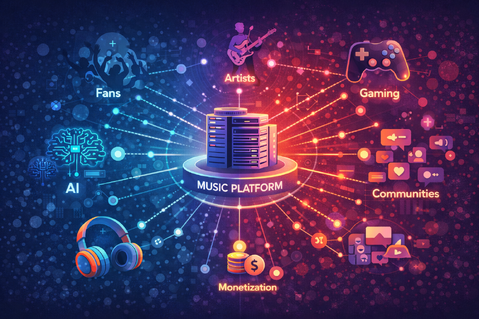
Platforms like Tuned Global operates within this infrastructure layer, enabling these systems, supporting the flow of metadata, licensing and reporting across partners, and helping turn attribution into something that can be implemented at scale.
This is where the industry stands today.
What comes next for AI music and fraud prevention
AI is not slowing down. The volume, complexity and ambiguity of music content will continue to increase.
The question is no longer whether the industry can detect AI-generated music. It is whether it can build systems that ensure:
- creators are properly attributed
- rights are clearly defined
- revenue is distributed fairly
- AI-driven fraud is mitigated
The foundations for this exist, but they need to evolve quickly. Because AI music fraud is not a future problem.
It is already here. And the systems to manage it are still catching up.
Join the conversation at Music Biz 2026
These topics will be explored further at Music Biz 2026 during the panel:
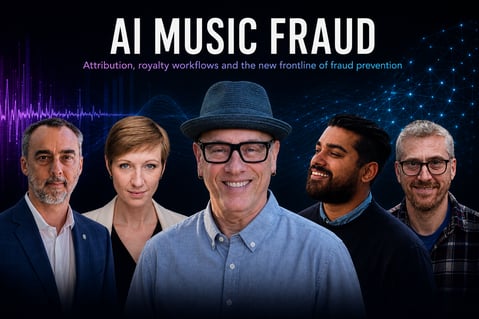
AI Music Management: Attribution, Royalty Workflows and the New Frontline of Fraud Prevention | Tuesday, May 12 12 – 12:40 PM ET
Featuring:
- Larry Mills, Vobile
- Bill Colitre, Music Reports
- Nathalie Birocheau, Ircam Amplify
- Rasha Rahman, HumanStandard
- Andrew Stess, Tuned Global
The session will dive deeper into:
- AI music attribution challenges
- royalty workflows for hybrid content
- fraud prevention across the music supply chain
If you are working at the intersection of music, technology and rights, this is a conversation you will want to be part of.
Frequently asked questions about AI music attribution and fraud
What is AI music fraud?
AI music fraud refers to the misuse of generative AI to create, distribute or monetise music without proper rights, including voice cloning, style imitation, synthetic catalogue flooding and metadata manipulation.
Why is AI music attribution difficult?
Attribution is difficult because AI-generated music often combines human and machine input. This makes it harder to determine ownership, assign rights and calculate royalties accurately.
Are current royalty workflows suitable for AI-generated music?
No. Existing royalty systems were designed for human-created content and struggle to handle hybrid or AI-generated works where ownership is less clearly defined.
What is the difference between detection and attribution?
Detection identifies whether content is AI-generated. Attribution goes further by determining how the content was created and who should be credited and compensated.
How can the music industry prevent AI-driven fraud?
Preventing AI-driven fraud requires a combination of better metadata, AI-assisted identification, verification tools and infrastructure that supports transparent rights management and royalty distribution.